Why Trust is the Only Math Your Business Needs to Master
The "Soft Skill" Myth
In the high-stakes world of service-based business, trust is frequently dismissed as a "soft skill"—a vague branding concept relegated to mission statements and "About Us" pages. When growth plateaus or lead conversion stalls, the traditional executive instinct is to increase the marketing budget, buying more traffic and higher ad placement to force a result.
This is a strategic error. As a growth consultant, I see this daily: businesses pouring capital into a leaky bucket. Data-driven analysis proves that trust is not an abstract emotion; it is a measurable, mathematical growth lever. The struggle to convert leads is rarely a "traffic" problem; it is a trust deficit. By treating trust as a variable in a hard equation, organizations can shift from expensive guesswork to predictable, compounding scaling.
Takeaway 1: The Trust Equation is Your New Growth Blueprint
To transform trust from a concept into a calculation, you must adopt a formal framework:
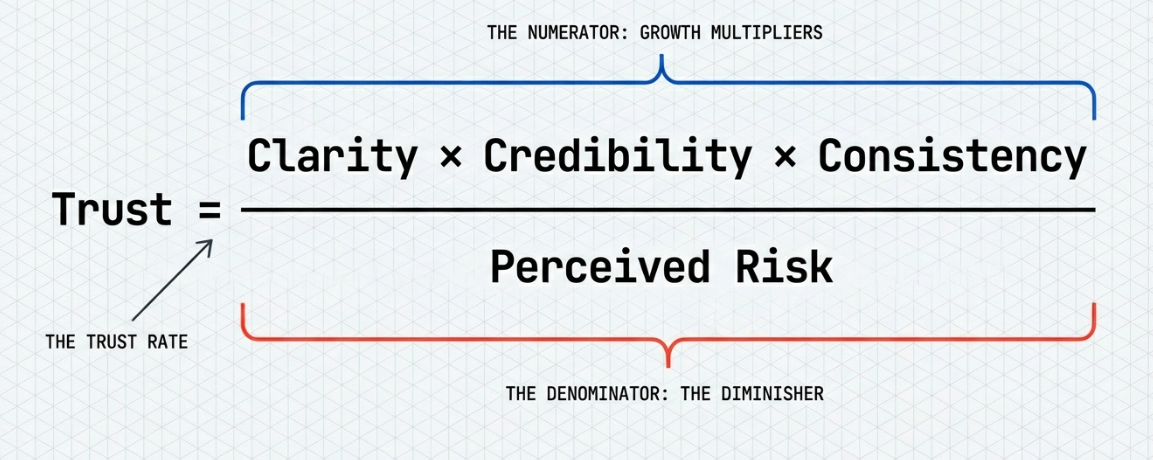
This equation exposes why most marketing campaigns fail. Businesses focus almost exclusively on the numerator—shouting louder about their services—while ignoring the denominator: Perceived Risk. If the perceived risk (the fear of being overcharged, pressured, or receiving poor service) remains high, it divides and diminishes the impact of every dollar spent on the top half of the equation.
Shifting from "branding" to "mathematical certainty" changes your entire perspective. You are no longer just "making ads"; you are optimizing a formula where every improvement to clarity or credibility compounds the final result, and every reduction in risk multiplies the output.
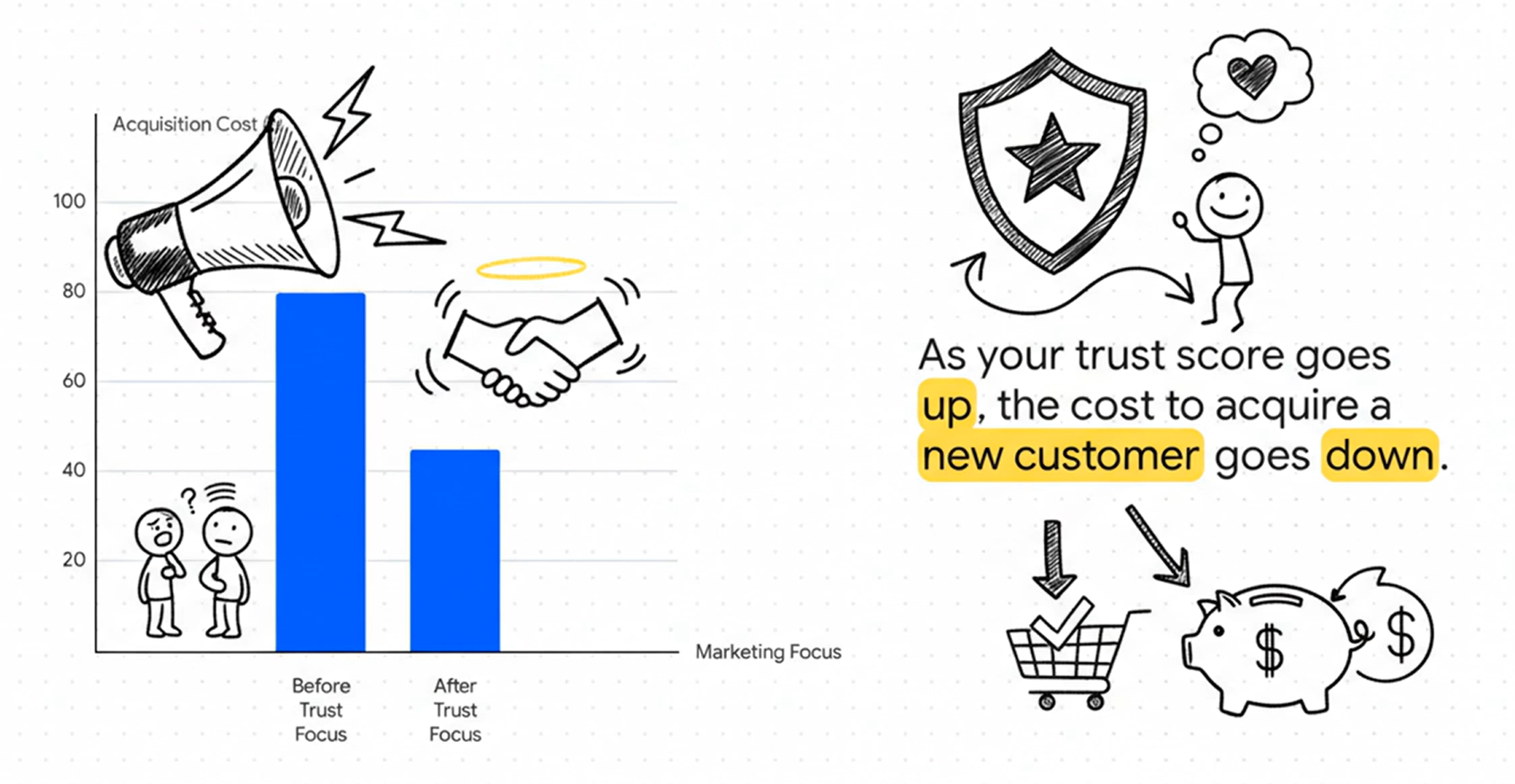
"When trust compounds, conversion rates rise, close rates improve, sales cycles shorten, customer acquisition costs (CAC) drop, and lifetime value (LTV) increases."
Takeaway 2: The Math of Clarity: Diagnosing Friction via Digital Ratios
Clarity is not about how you "feel" about your message; it is a diagnostic tool for a broken funnel. In the service industry, confused prospects do not convert. Clarity is quantified by how quickly a prospect understands your value proposition and the path to purchase.
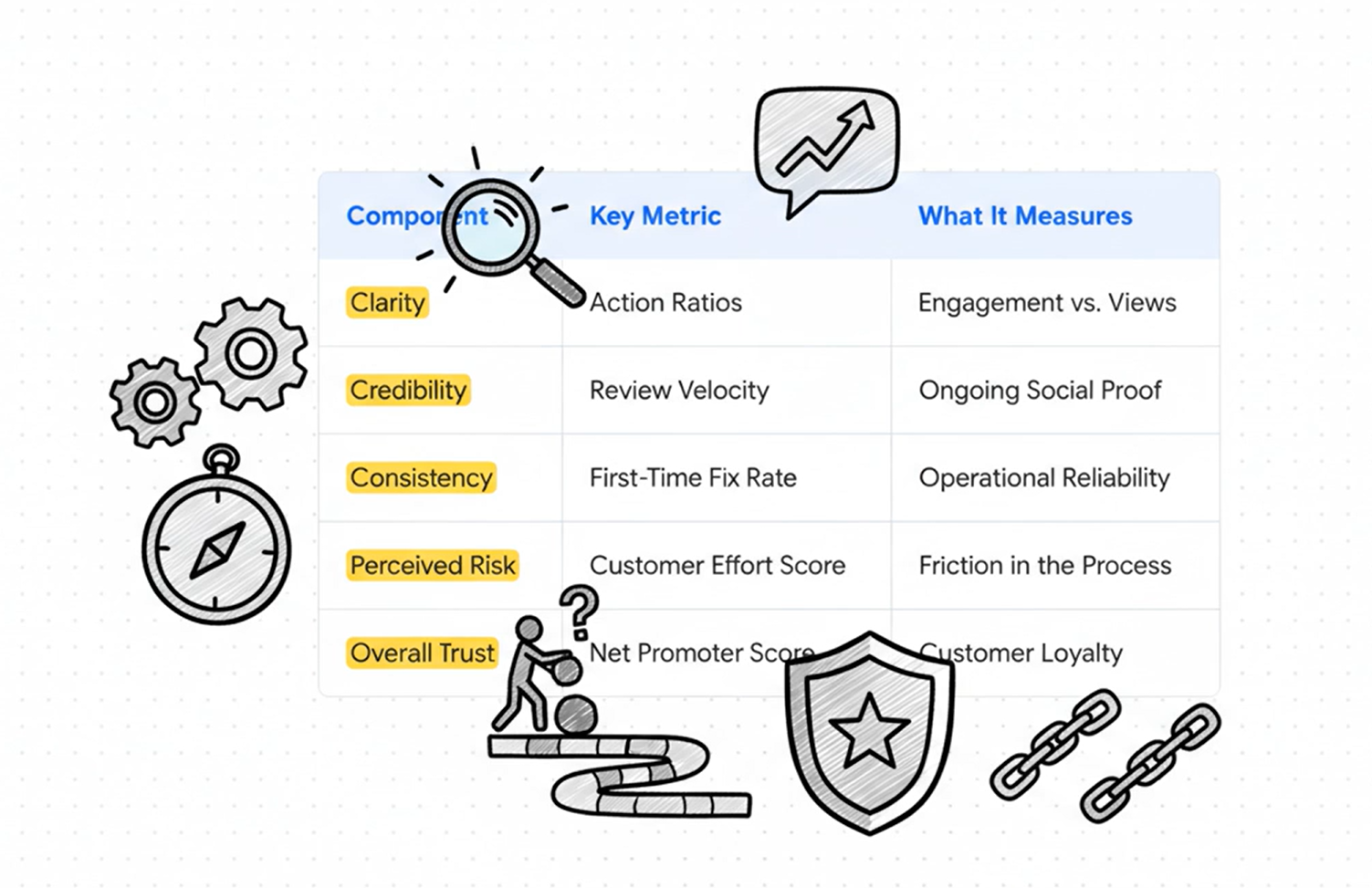
- Action Ratios: On your Google Business Profile (GBP), look at the ratio of "Views" to "Customer Actions" (calls, website clicks, direction requests). A high volume of views paired with weak action rates is a mathematical signal that your messaging lacks clarity or fails to trigger psychological engagement.
- Website Bounce Rates: High bounce rates on specific landing pages are rarely a "lead quality" issue; they are a clarity failure. If your site uses industry jargon or buries the "Book Now" CTA below the fold, you are intentionally introducing friction into the equation.
Takeaway 3: Credibility Velocity and the Evidence of Value
Credibility is driven by evidence, but a static star rating is no longer a sufficient competitive advantage. True credibility has "velocity"—a measure of the volume and frequency of proof.
To win, you must track and optimize specific credibility markers:
- Review Velocity: The frequency of new reviews is often more predictive of trust than the average score itself. A sudden increase in review volume correlates directly with higher engagement.
- "The 21-Point Inspection Checklist": Transparency is a credibility multiplier. Providing tangible proof of value—such as a detailed 21-point inspection checklist—eliminates the fear of hidden costs and proves expertise.
- Visual Proof: Before-and-after photos and videos of technicians in the field provide immediate, tangible evidence of competency.
- The 35% Benchmark: When your credibility math is working, your Referral Rate—the percentage of total sales coming from word-of-mouth—should climb to 35% or more. This is the ultimate indicator of a healthy numerator.
Takeaway 4: The Silent Killer—The "Risk" Denominator
Perceived risk represents the customer’s anxiety and the physical/emotional effort required to work with you. In service calls—especially emergencies like a burst pipe in winter—the customer’s stress is already at a peak, making the denominator massive.
To maintain a high trust score, you must aggressively drive down this denominator:
Customer Effort Score (CES): This is a critical KPI that measures the time and friction a customer expends to resolve an issue or book an appointment. High effort directly correlates with high perceived risk and frustration.
Technician Tracking: Wasting a day waiting for a technician who never shows up is a major customer fear. Using live GPS tracking and automated SMS arrival updates gives the customer a sense of control, neutralizing "waiting anxiety".
Upfront Flat-Rate Pricing & Zero Dispatch Fees: Offering upfront, flat-rate pricing and providing written guarantees eliminates the financial fear of hidden costs, "the ticking clock," or high-pressure upselling. To truly reduce financial friction, eliminate the "dispatch fee." Charging a customer just to get a truck out of the garage and diagnose the problem adds massive friction. Homeowners do not want to pay hundreds of dollars just for a technician to look at a problem without actually solving it.
"The higher the perceived risk, the lower the trust score."
Takeaway 5: Operational Consistency as a Non-Negotiable KPI
Your marketing spend is a total loss the moment your operational delivery contradicts your brand promise. Trust collapses when there is a disconnect between the "white-glove" ad and the rude dispatcher.
Consistency must be tracked through two non-negotiable metrics:
- First-Time Fix Rate (FTFR): This calculates the percentage of service calls resolved successfully on the first visit. It is the mathematical reflection of your operational reliability and technical competency.
- NAP Consistency: Maintaining uniform Name, Address, and Phone number data across all local directories (Google, Yelp, Angi) is not just for humans; it is a critical trust signal for search engines. Inconsistent data signals a lack of legitimacy, damaging your local SEO and your customer's confidence simultaneously.
Takeaway 6: The "Negative Persona" Filter
Increasing your trust score often requires the counter-intuitive move of saying "no." By identifying and filtering out Negative Personas—such as "Bargain Brenda" or the "Freebie Hunter"—you protect your trust equation.
These personas do more than just cost more in CAC; they actually inflate the denominator for your ideal customers by draining resources and focus that should be spent on reducing friction for high-value clients. Filtering these prospects out allows your team to focus entirely on a premium, low-risk experience, which lowers long-term CAC by ensuring every resource is dedicated to the highest possible LTV.
Conclusion: Compounding Trust for Long-Term Velocity
When trust is treated as a mathematical certainty, the performance implications are undeniable. The ultimate proxy for this equation is the Net Promoter Score (NPS). To calculate it, subtract the percentage of "detractors" (customers who rate you 0–6) from the percentage of "promoters" (those who rate you 9–10).
A rising NPS, combined with a high FTFR and low CES, proves that your trust math is compounding. This acceleration leads to lower CAC, higher LTV, and shorter sales cycles. Trust is not a buzzword; it is the engine of velocity.
Audit your math today: If you calculated your business's Trust Rate right now, would the data tell you to buy more ads, or would it demand that you finally fix your denominator?