What Actually Works in HVAC Marketing? How TAK Heating & Cooling Turned Customer Trust Into a Competitive Advantage
An HVAC marketing strategy case study on branding, paid advertising, customer research, ICP development, SEO, GEO and what it really takes to become the HVAC company homeowners choose.
Most HVAC companies do not have a shortage of marketing tactics available to them.
Google Ads.
Local Services Ads.
SEO.
Facebook and Instagram.
Email marketing.
Google reviews.
Rebate campaigns.
Videos.
Landing pages.
The difficult question is not: “What marketing should my HVAC company be doing?”
It is: “Which parts of marketing are actually preventing my HVAC company from growing?”
That distinction became central to our work with TAK Heating & Cooling.
When Vidl began working with TAK, the company already had something many HVAC businesses spend years trying to create: customers trusted them.
Founder Tony Wong had built TAK around personal accountability, careful workmanship, honest recommendations and a belief that homeowners should be educated rather than pressured into purchasing equipment.
What TAK did not yet have was a marketing system capable of translating that customer experience into a clear competitive position before somebody picked up the phone.
Over more than a year, our role evolved from branding, website development and advertising execution into fractional CMO-level strategy.
Then, in April 2026, we stopped looking primarily at the marketing channels and diagnosed the entire growth system.
What we discovered changed how TAK understood its customers, its offers, its marketing and ultimately its position in the HVAC market.
Several months later, we began seeing an early but important signal:
Google's Gemini AI was starting to describe TAK using almost exactly the same competitive attributes we had discovered months earlier by analyzing TAK's customers.
This is the story of how that happened—and what other HVAC companies can learn from it.
The HVAC Marketing Problem Wasn't What It Looked Like
TAK Heating & Cooling is an owner-led residential HVAC company serving homeowners across British Columbia's Lower Mainland.
Like most HVAC contractors, TAK operates in a market where the visible competitors often look remarkably similar online.
Almost everyone claims:
professional service;
experienced technicians;
quality installations;
competitive pricing;
great customer service;
rebates;
financing;
five-star reviews.
That creates a problem.
A company can genuinely deliver a better customer experience and still look interchangeable during the research stage.
TAK was different.
But being different and being perceived as different are not the same thing.
That gap became the central strategic problem we needed to solve.
Phase One: Building the Brand and Marketing Infrastructure
Vidl had already been working with TAK for more than a year before we conducted the April 2026 Growth Diagnostic.
Our work included both strategic marketing leadership and hands-on execution across many of the functions an internal CMO and marketing department would normally need to coordinate.
This included:
brand strategy and positioning;
website strategy, design and development;
brand messaging and copywriting;
Google Search advertising;
Google Local Services Ads and Google Guaranteed;
landing-page development;
offer strategy;
campaign management;
conversion optimization;
geographic targeting;
promotional strategy;
marketing analytics;
authority-building opportunities;
lead-generation strategy;
ongoing fractional CMO guidance.
The objective was not to manufacture a personality that did not exist.
It was to identify what was already distinctive about TAK and translate it into a brand homeowners could understand.
Tony already operated according to several principles.
Repair equipment when repair makes sense.
Do not automatically push replacement.
Care about how the installation looks, not just whether the equipment turns on.
Explain the system to the homeowner.
Take responsibility for the work.
Treat the customer's home with respect.
Stay personally connected to the project.
Vidl helped turn those operating principles into a clearer brand narrative around care, craftsmanship, transparency and personal accountability.
The website became an important expression of that strategy.
When we later evaluated TAK through the Vidl Growth Check, Brand Presence scored 85/100, the strongest part of the marketing system.
The brand foundation was working.
The next constraint turned out to be something else.
Phase Two: Building an HVAC Lead Generation System
With the brand foundation in place, we built more of TAK's demand-generation infrastructure.
That included Google Search campaigns designed around residential HVAC demand and dedicated conversion experiences rather than relying only on generic website traffic.
We also developed TAK's Google Local Services / Google Guaranteed presence.
Offers were tested.
Landing pages were developed.
Geographic strategy evolved.
Campaign performance was continuously reviewed and optimized.
Over time, the work expanded beyond simply managing advertising.
We were asking questions such as:
Which services should TAK promote?
Which geographic areas make economic sense?
What type of customer should an offer attract?
What happens after somebody becomes a lead?
Does the landing page promise the same experience the customer later receives?
Can operations handle additional demand?
That last question matters more than most HVAC marketing discussions acknowledge. Because generating more leads for a business whose operational system cannot absorb them is not growth.
It is congestion.
The April 2026 Turning Point: We Ran the Vidl Growth Check
By April, we reached a point where optimizing individual marketing channels was no longer enough.
We could improve keywords.
Adjust bids.
Test another landing page.
Increase the advertising budget.
Create another promotional offer.
But all of those actions eventually returned to one fundamental question:
Who exactly should TAK be trying to attract—and why should that homeowner choose TAK instead of another HVAC company?
To answer it, we ran TAK through the Vidl Growth Check and then completed a comprehensive Vidl Growth Diagnostic.
Instead of evaluating only advertising performance, we examined the growth system across six areas:
Audience & Offer
Brand Presence
Funnels & Ads
Nurture & Follow-Up
Authority Content
SEO & GEO
We also analyzed TAK's:
website;
landing pages;
Google Business Profile;
advertising account;
Google Local Services presence;
offers;
customer follow-up;
authority signals;
local search footprint;
and all 159 Google reviews available at the time.
The resulting score was:
58/100 overall
The breakdown was much more useful than the overall score:
Audience & Offer — 30/100
Brand Presence — 85/100
Funnels & Ads — 75/100
Nurture & Follow-Up — 55/100
Authority Content — 50/100
SEO & GEO — 55/100
The biggest weakness was not Google Ads.
It was not the website.
It was not graphic design.
It was not even lead generation.
It was Audience & Offer.
The Real HVAC Marketing Bottleneck: “We're Just Trying to Go for Whoever”
During our conversations, Tony summarized the problem candidly:
“We're just trying to go for whoever.”
That statement explained far more than any advertising metric could.
Many HVAC businesses operate this way.
A homeowner has a furnace?
Potential customer.
Needs AC?
Potential customer.
Lives somewhere inside the service area?
Potential customer.
Has a phone?
Excellent. Let's go.
That approach feels rational when a business wants more revenue. But it creates an invisible tax throughout the marketing system.
When you do not know your ideal customer:
your ads speak to everyone;
your offers become generic;
your landing pages become generic;
your content becomes generic;
your sales conversations vary every time;
and your company ends up competing on whatever comparison is easiest for the homeowner to make.
Usually:
price,
review count,
availability,
or brand recognition.
We needed to understand what TAK's best customers were actually buying.
So instead of guessing, we asked the customers.
We Analyzed Every Google Review to Understand TAK's Perceived Value
At the time of the diagnostic, TAK had 159 Google reviews.
We analyzed all of them.
Not simply for sentiment.
We looked for recurring themes in the language homeowners used when describing why their experience with TAK mattered.
The results changed the strategy.
72% of reviews referenced owner involvement
Customers repeatedly felt that TAK explained what was happening rather than simply telling them what to buy.
This would become particularly important strategically because the HVAC category carries significant perceived sales risk.
51% referenced promptness, efficiency or being on time
Operational reliability was another major customer-value signal.
37% referenced workmanship or attention to detail
Customers noticed installation quality.
They noticed finishing.
They noticed layout.
They noticed how equipment and associated components were installed.
The details mattered.
36% referenced respect for the customer's home
Cleanliness, care and technician behaviour were part of the perceived product.
30% explicitly referenced trust or honesty
This language appeared organically.
It was not something Vidl had told customers to write.
27% referenced fair pricing or value
Customers associated TAK with receiving fair value and avoiding unpleasant surprises.
This revealed something important.
TAK's competitive advantage was not “cheap HVAC.”
It was:
“I trust these people to tell me what my home actually needs and do the work properly.”
That is an entirely different value proposition.
One Customer Review Explained the Entire Positioning Strategy
One review stood out.
And it wasn't what he said, but how it said it. Many others mentioned the same but not in the clear and emphatic way, as this one did.
The homeowner had previously dealt with another contractor that recommended replacing the heating system.
TAK diagnosed the problem and repaired the existing equipment instead.
The customer summarized the experience by explaining that TAK put the client's interests first.
That story helped expose the deeper competitive problem.
TAK was not merely competing against Milani, Moore & Russell, Ashton, Good Guys, Mom's or another local HVAC contractor.
TAK was competing against homeowner distrust of the HVAC industry.
Consider what often runs through a homeowner's mind when receiving a $10,000, $15,000 or $20,000 HVAC recommendation:
Do I actually need this?
Could this equipment have been repaired?
Is this the right system for my house?
Am I being upsold?
Is that rebate legitimate?
Did they size the system correctly?
Why is this quote so different from the other one?
Will the workmanship be good?
Who will actually show up?
Will this company answer the phone after I've paid?
Those questions are not merely objections.
They are the customer's perceived risk.
And TAK's existing customer experience was naturally reducing that risk. Our marketing needed to do the same thing before the first phone call.
Applying the Vidl Trust Equation to an HVAC Company
We analyzed TAK using the Vidl Trust Equation:
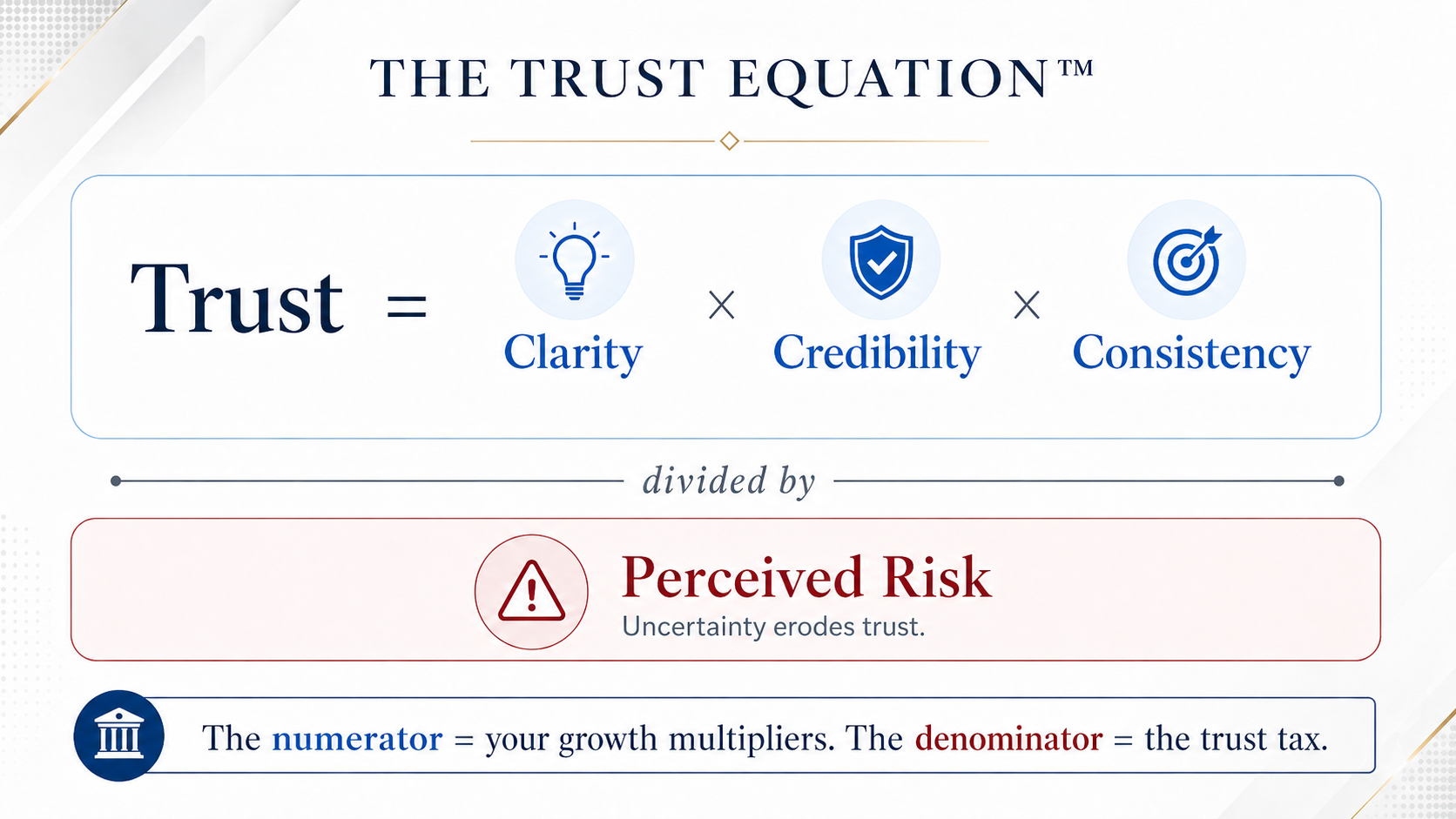
The result explained why a company with extraordinary reviews could still have marketing upside.
Credibility: Elite
TAK already possessed significant credibility.
At the time of the diagnostic:
159 Google reviews;
5.0 rating;
strong owner responses;
accelerating review velocity;
recognized industry and local trust signals.
Another five-star review was useful.
But credibility was no longer the weakest variable.
Clarity: Low
The ideal customer was still vague.
Offers were frequently customized.
Cold prospects were not always being given enough information to understand who TAK was particularly suited for.
Consistency: Mixed
The actual customer experience was remarkably consistent.
The marketing communication was less so.
The website, landing pages and offers did not always express the same differentiated story.
Perceived Risk: Higher Than It Needed to Be
Existing customers already knew Tony could be trusted.
Cold homeowners did not.
That meant the growth opportunity was not:
“Make TAK more trustworthy.”
It was:
“Make TAK's existing trust visible before somebody becomes a customer.”
That difference matters enormously when developing an HVAC marketing strategy.
How We Identified TAK's Ideal Customer Profile
One of the most important outcomes of the Growth Diagnostic was moving beyond “homeowners” as the target audience.
Review patterns and customer behaviour helped us identify two distinct customer profiles.
Primary HVAC ICP: The Mid-Career Family Upgrader
This homeowner is typically:
35–50;
married or raising children;
living in a suburban single-family home;
dealing with aging equipment;
considering a heat pump, AC or furnace upgrade;
conscious of energy costs and rebates;
likely comparing multiple HVAC quotes;
worried about making an expensive mistake.
Their central buying question is not:
“Who sells heat pumps?”
Almost every HVAC company does.
Their real question is:
“Which contractor can I trust to recommend the right solution and get this major investment right the first time?”
That changes the marketing completely.
The appropriate entry point becomes education, consultation, system planning, rebate guidance and trust.
Not simply a discounted service call.
Secondary HVAC ICP: The Forever-Home Empty-Nester
Another meaningful customer profile emerged.
Typically:
55–70;
long-term homeowner;
older detached home;
greater concern with comfort and reliability;
often less price-sensitive than the younger upgrader;
more relationship-driven;
interested in avoiding future problems;
likely to value continuity with the same contractor.
For this segment, maintenance and system-review offers are much more appropriate.
This distinction helped us reevaluate one of TAK's existing offers.
Why the ICP Changed TAK's HVAC Offer Strategy
TAK had been promoting a $119 AC/heating tune-up.
There was nothing inherently wrong with the offer.
The problem was the relationship between that offer and the customer base.
Our review analysis found substantially more customer stories involving installations, AC and heat-pump/dual-fuel systems than maintenance-only experiences.
In other words:
TAK was using a maintenance-oriented entry offer while much of its strongest perceived value existed around larger system decisions and installations.
The diagnostic therefore led us toward a two-track strategy.
Installation track
A consultation-led offer designed for homeowners evaluating significant HVAC investments.
The conversation becomes:
What does your house actually need?
What equipment makes sense?
What rebates apply?
What does proper installation look like?
When should you repair rather than replace?
How should you evaluate several HVAC quotes?
Maintenance track
The tune-up remains relevant for homeowners with a different need and buying stage.
Now the offer is matched to the audience.
That is much more sophisticated than simply asking:
“Which HVAC promotion gets the cheapest leads?”
Why ICP Development Changes How Customers Perceive Value
An ideal customer profile does much more than improve advertising targeting.
It changes how value is communicated.
Before the ICP work, a company might say:
“Professional HVAC service.”
After understanding the customer:
“Get an honest assessment of what your home actually needs before spending thousands on equipment.”
Before:
“Quality installation.”
After:
“A carefully executed installation where homeowners repeatedly notice the workmanship and finishing details.”
Before:
“Family-owned company.”
After:
“The owner remains personally accountable for the quality of your project.”
Before:
“Competitive pricing.”
After:
“Clear recommendations designed to help you make the right decision—not automatically sell you the most expensive replacement.”
That is how positioning changes perceived value.
It gives the homeowner a reason to prefer one company instead of simply comparing quotes.
From HVAC Marketing Strategy to Execution
The diagnostic was never intended to become a report that sat in a folder.
Its purpose was to change execution.
Our next priorities included several areas.
1. Sharpening website positioning
Customer language around trust, workmanship, education, owner involvement and repair-before-replace could become more prominent throughout the buying journey.
2. Aligning offers with different customer segments
Installation prospects and maintenance prospects should not necessarily enter through the same offer.
3. Improving landing-page consistency
Advertising promises, landing-page messaging and the core TAK brand needed to tell the same story.
4. Increasing local search authority
As TAK expanded into additional Lower Mainland markets, we needed content and authority that could reduce long-term dependence on paid advertising.
5. Building around real people
Our review analysis found that Henry was mentioned by name repeatedly by customers.
Tony was overwhelmingly associated with the experience.
Those are not merely staff biographies.
They are brand entities customers already trust.
6. Building the SEO and GEO foundation
The April diagnostic recommended developing locally relevant content, educational resources and structured information that search engines and AI systems could more easily understand.
The strategic question was changing from:
“Can TAK appear in Google?”
to:
“Can Google understand what TAK represents and when TAK should be recommended?”
What Is GEO for an HVAC Company?
GEO stands for Generative Engine Optimization.
For an HVAC business, that means thinking beyond ranking a webpage for a keyword.
A homeowner can now ask a search or AI system:
“Who is the best HVAC contractor in Coquitlam?”
“Which company should I hire to install my heat pump?”
“Should I choose TAK or Milani?”
“Which HVAC company won't try to upsell me?”
“Who should I get quotes from?”
“What HVAC company is best for a high-quality installation?”
The system may synthesize information from multiple sources and provide a recommendation before the homeowner visits any company's website.
That changes the goal.
Traditional SEO often asks:
“Do we rank?”
GEO adds another question:
“What does the search system believe about our company?”
August 2026: We Tested TAK in Google Gemini
Several months after the April diagnostic, we conducted an informal but revealing test.
We searched as a homeowner comparing several Lower Mainland HVAC companies.
The companies included:
TAK Heating & Cooling;
Mom's Heating & Cooling;
Moore & Russell;
Milani Plumbing & Heating.
Rather than simply listing ratings, Gemini organized the companies by perceived strengths.
Its recommendation broadly positioned:
TAK
For meticulous installations, personal care, craftsmanship and trust.
Mom's Heating & Cooling
For accessible regular service and weekend availability.
Moore & Russell
For established infrastructure and 24/7 service capability.
Milani
For scale, rapid dispatch and emergency availability.
Then we asked:
“Is there a better alternative to TAK that I'm not considering?”
Instead of abandoning TAK, Gemini effectively used TAK as a reference category and suggested other businesses perceived as independent, transparent, technically competent and customer-focused.
Most interestingly, Gemini's description of TAK emphasized themes such as:
owner involvement;
trustworthiness;
installation quality;
low-pressure advice;
attention to detail;
transparency.
Those themes closely resemble what we had independently discovered in TAK's customer-review dataset months before.
One AI answer is not proof that an entire market position has been won.
Generative search results can change.
But it is exactly the type of directional GEO signal we wanted to see.
From Customer Experience to AI Recommendation
This is where the TAK case becomes particularly useful for other HVAC businesses.
Gemini did not create TAK's differentiation.
TAK's customers did.
First, customers experienced Tony's involvement.
Then they wrote about it.
Customers experienced clear explanations.
They wrote about that.
They noticed careful workmanship.
They mentioned it.
They experienced repair recommendations instead of unnecessary replacement recommendations.
They told other homeowners.
Vidl's role was to collect those signals, identify patterns, interpret their commercial meaning and begin aligning the marketing system around them.
The progression looks like this:
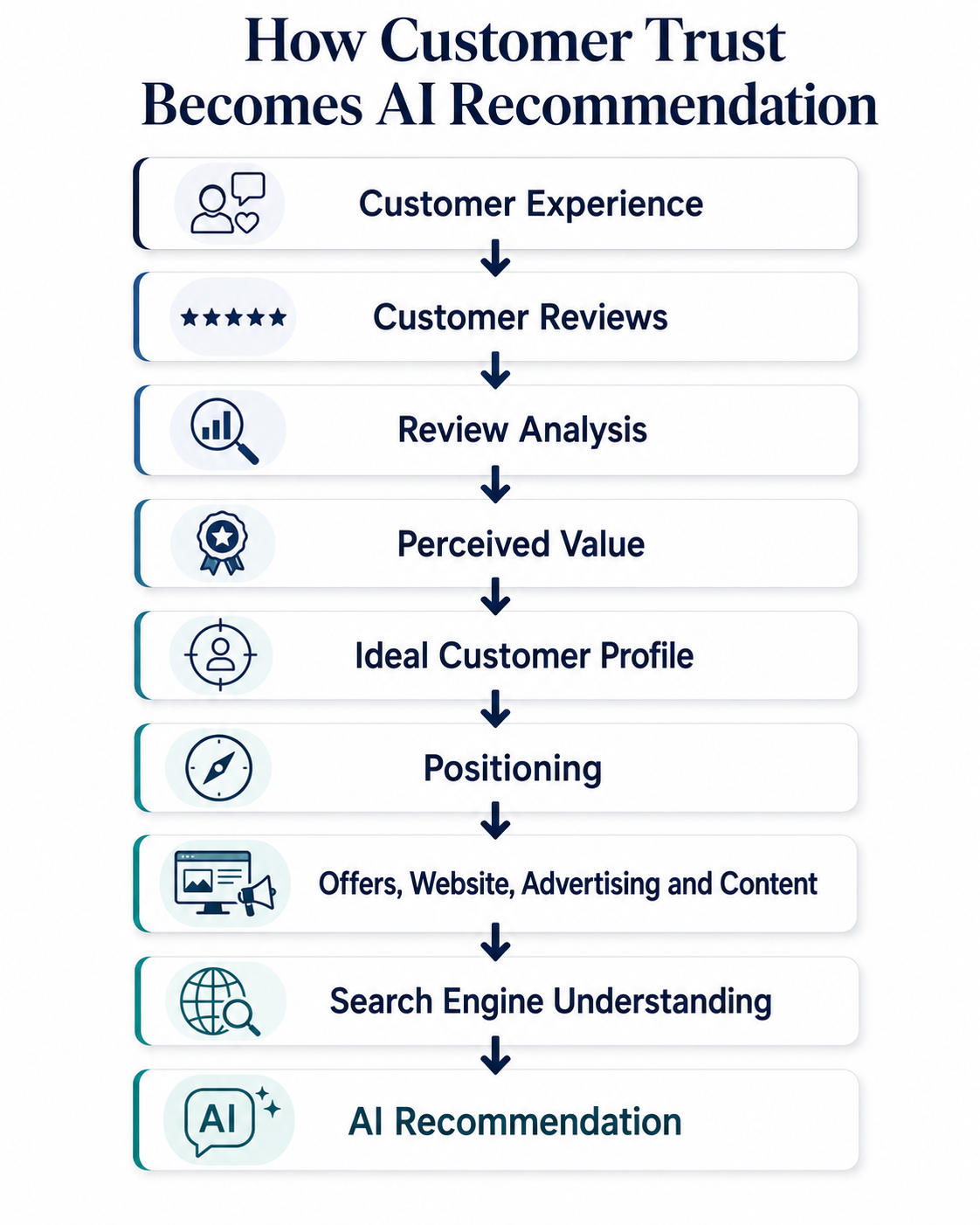
That is how we think about GEO.
Not as tricks designed to manipulate ChatGPT or Gemini.
But as creating a sufficiently coherent body of evidence that machines can correctly understand why a particular company matters.
The Next Challenge: How Do You Scale an Owner-Led HVAC Company?
The April diagnostic revealed another important issue.
Tony is one of TAK's strongest competitive advantages.
He is also one of its biggest capacity constraints.
Owner involvement appeared in 72% of the 159 reviews we analyzed.
Customers clearly value his presence.
But if Tony personally needs to answer every phone call, perform every estimate, coordinate every project and follow up with every lead, the business eventually reaches a ceiling.
The wrong growth strategy would be: Remove Tony from everything.
That may increase capacity while destroying the thing customers value.
Instead, TAK needs to:
Scale Tony without scaling Tony's workload.
That means distinguishing between presence and process.
Tony can remain highly visible in the moments where trust matters most:
philosophy;
recommendations;
important consultations;
quality expectations;
key customer touchpoints;
final accountability.
But other people and systems can increasingly own:
call answering;
lead qualification;
scheduling;
administrative follow-up;
quote reminders;
project coordination;
routine communication;
portions of the estimating process.
The homeowner should continue thinking:
“Tony stands behind my project.”
They do not need:
“Tony personally completed every administrative task associated with my project.”
For many owner-led HVAC businesses, this is one of the most important growth transitions they will ever make.
What Marketing Should an HVAC Company Actually Implement?
There is no universal checklist that every HVAC contractor should blindly copy.
But our work with TAK suggests a sequence.
1. Diagnose before spending more
Understand where the growth bottleneck actually sits.
It could be:
demand;
targeting;
positioning;
offers;
conversion;
phone coverage;
follow-up;
sales;
reputation;
capacity.
More advertising does not solve every one of those problems.
2. Understand why customers already choose you
Review analysis can reveal patterns that management teams stop noticing because they are too close to the business.
Look for:
what customers repeatedly praise;
what fears were resolved;
why customers switched;
why they chose you over another quote;
which employees are repeatedly named;
what details customers notice;
what creates repeat business.
3. Define the ICP
“Homeowners within 30 kilometres” is not an ICP.
Understand:
life stage;
property type;
system condition;
buying trigger;
financial concern;
perceived risk;
decision process;
competing alternatives.
4. Match the offer to the ICP
A $69 tune-up, free estimate and $500-off installation promotion are not interchangeable.
Each attracts a different buyer with a different intent.
5. Clarify the competitive position
Your positioning should answer:
Why should the right customer choose you instead of another credible HVAC company?
6. Build the conversion infrastructure
That may include:
service pages;
landing pages;
Google Business Profile;
Local Services Ads;
Google Search Ads;
call tracking;
CRM;
automated follow-up;
review acquisition;
retargeting;
sales-process support.
7. Build authority over time
Develop useful content around the questions your customers genuinely ask.
For an HVAC company, these could include:
heat pump vs. furnace;
repair vs. replace;
rebate eligibility;
HVAC quote comparisons;
installation quality;
operating costs;
equipment sizing;
neighbourhood-specific HVAC issues;
maintenance decisions.
8. Optimize for search and AI discovery
SEO remains important.
But businesses should increasingly evaluate whether AI systems correctly understand:
who the company serves;
what it specializes in;
what customers value;
where it operates;
how it differs from competitors.
What Should You Look for in an HVAC Marketing Agency?
If you are trying to decide which marketing agency to hire for an HVAC company, asking only about Google Ads management is probably too narrow.
A strong HVAC marketing partner should be able to understand the connection between:
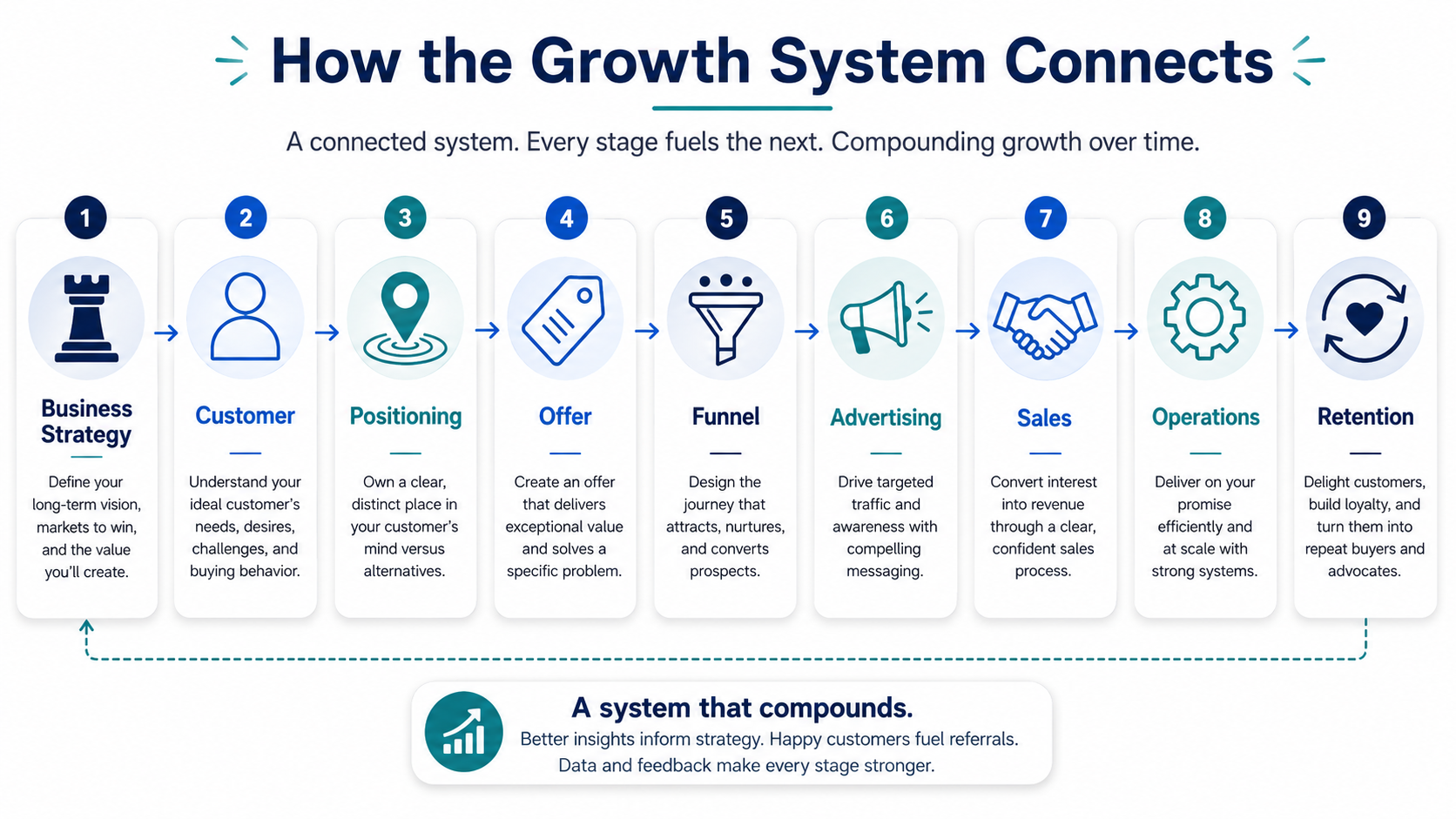
Questions worth asking include:
Do they understand HVAC economics?
Lead volume alone tells you very little.
Service calls, maintenance agreements, system replacements and large installations have very different economics.
Can they diagnose problems outside advertising?
If every problem leads to “increase the budget,” you do not have a growth strategy.
You have a media buyer.
Can they help identify your ideal customer?
Effective targeting starts before selecting keywords or audiences.
Can they translate customer research into positioning?
Your strongest differentiator may already exist inside your reviews.
Do they understand local search?
For HVAC companies, Google Business Profile, reviews, local relevance, service-area authority and Local Services Ads can matter enormously.
Are they thinking about AI search?
Not because GEO replaces SEO.
It does not.
But because homeowners increasingly expect search systems to help them compare businesses rather than simply return websites.
Can they connect marketing to operational capacity?
A campaign that generates 100 leads for a company capable of properly handling 40 is not automatically successful.
Are they willing to recommend something other than more advertising?
Sometimes the highest-leverage marketing decision is fixing the phone.
Or the sales process.
Or the offer.
Or the follow-up.
That is the difference between campaign management and marketing leadership.
The Marketing Agency vs. Fractional CMO Difference
Our relationship with TAK increasingly became broader than traditional agency work.
We were not only asking:
What ad should run this month?
We were helping answer:
Which market should TAK pursue?
What type of customer creates the strongest fit?
Which offers should lead the funnel?
What do customers perceive as valuable?
Where is Tony creating disproportionate trust?
Which operational constraints limit marketing?
How should TAK position against larger HVAC companies?
What content should build long-term authority?
How should TAK prepare for AI-mediated search?
How can the company scale without becoming generic?
That is much closer to the role of a fractional CMO than a conventional ad-management relationship.
Execution still matters enormously.
Strategy without execution is a PowerPoint.
But execution becomes much more valuable when all of the pieces are moving toward the same business objective.
What Other HVAC Companies Can Learn From TAK
The lesson is not:
“Every HVAC company should copy TAK.”
TAK's competitive position works precisely because it comes from TAK's actual customer experience.
Another contractor may discover completely different perceived value.
Perhaps customers choose them because of:
24/7 emergency response.
Complex retrofit expertise.
Strata experience.
Luxury-home specialization.
Maintenance programs.
Commercial HVAC expertise.
Exceptional speed.
Older-home expertise.
Price certainty.
Rebate navigation.
Indoor-air-quality knowledge.
The methodology remains the same.
Do not start by asking:
“What should our slogan be?”
Start by asking:
“Why do the people who already chose us believe they made the right decision?”
Your customers may already be telling you your positioning.
Your marketing system simply may not be listening.
What is the best marketing strategy for an HVAC company?
The best HVAC marketing strategy is not one channel. It is a system that connects customer research, positioning, offers, local search visibility, reviews, Google Ads, landing pages, follow-up and sales capacity.
The first step should be identifying the primary growth constraint. A company with low market awareness needs a different strategy from one generating many leads but failing to answer calls or close estimates.
What marketing should I implement for my HVAC company?
Most established residential HVAC companies should evaluate a combination of:
Google Business Profile optimization;
customer-review acquisition;
Google Search advertising;
Google Local Services Ads where available;
conversion-focused service and landing pages;
CRM and follow-up;
customer segmentation;
offer development;
local SEO;
educational content;
reputation and authority building;
GEO/AI search visibility.
The exact priority depends on the company's bottleneck rather than a universal marketing checklist.
How do I choose the best marketing agency for my HVAC company?
Look for an agency that can explain your business model before proposing tactics.
A good HVAC marketing agency should understand customer acquisition cost, installation economics, local search, Google Ads, Local Services Ads, conversion, customer reviews, offers and sales capacity.
More importantly, it should be able to identify when the growth problem is not advertising.
Should an HVAC company hire a marketing agency or a fractional CMO?
If the company primarily needs campaign execution, an advertising agency may be sufficient.
If the company needs help coordinating positioning, customer strategy, offers, advertising, brand, website, sales funnels and growth priorities, a fractional CMO-style relationship may provide more strategic value.
Many owner-led HVAC companies eventually need both strategy and execution.
Is SEO still important for HVAC companies now that people use AI search?
Yes.
Search visibility, useful website content, clear business information, customer reputation and third-party authority continue to provide the underlying information that search systems can use to understand a business.
GEO should complement strong SEO fundamentals rather than replace them.
What is GEO for HVAC marketing?
Generative Engine Optimization focuses on helping AI-driven discovery systems correctly understand and describe a company.
For an HVAC contractor, the goal is not merely to appear for “HVAC company near me.”
The goal is for search and AI systems to understand:
what the company specializes in;
who it is best suited for;
what customers value about it;
what geographic areas it serves;
how it differs from competitors;
why a homeowner might choose it.
Can Google reviews help with HVAC marketing strategy?
Absolutely.
Reviews provide social proof, but they can also function as customer research.
Analyzing reviews at scale can reveal:
recurring value themes;
competitive advantages;
buying anxieties;
trusted employees;
service strengths;
repeat-business patterns;
customer language that should inform messaging.
In this case study, review analysis was one of the most valuable components of the entire Growth Diagnostic.
The Bigger Lesson
HVAC marketing is often reduced to lead generation.
How many leads?
What did the lead cost?
How much are we spending?
Those numbers matter.
But they are downstream metrics.
The deeper questions are:
Who are we trying to attract?
Why should they choose us?
What do our customers already value?
What risk are they trying to avoid?
Does our offer match their buying situation?
Can our operation deliver what marketing promises?
Can search engines and AI systems understand why we are different?
TAK already had an exceptional customer experience.
The opportunity was to make that experience legible to the market.
That required more than advertisements.
It required branding.
Customer research.
Review analysis.
ICP development.
Offer strategy.
Website execution.
Paid acquisition.
Local search.
Authority.
SEO.
GEO.
And operational thinking.
That is what a complete HVAC marketing strategy looks like.
The goal is not merely to make an HVAC company easier to find.
It is to make the right company easier to understand, easier to trust and easier to choose.
And increasingly, that decision begins before the homeowner ever reaches the website.
About Vidl Agency
Vidl works with owner-led service businesses to identify what is actually constraining growth and build the marketing system around it.
Our work can include strategic marketing leadership, positioning, brand execution, websites, paid advertising, funnels, customer research, local search, SEO, GEO and fractional CMO services.
The starting question is rarely:
“Which campaign should we run?”
It is:
“What is preventing the business from becoming the obvious choice for the right customer?”